When Two Health Information Systems Tell Different Stories: Lessons from Nigeria
A five-year comparison of ALMANACH and Nigeria's national Routine Health Information System (RHIS) reveals over 100,000 missing malaria cases between the two platforms. Published in PLOS Digital Health, this study makes a compelling case: parallel digital health tools must integrate with — not operate alongside — national health infrastructure to produce reliable evidence for policy and decision-making.
Jul 8, 2026
When Two Health Information Systems Tell Different Stories: Lessons from Nigeria
Can digital health improve national health information systems? Our latest research suggests that the answer is yes—but only if integration comes first.
Digital health has become one of the fastest-growing areas of global health investment. Clinical decision support systems, electronic medical records and mobile health applications are now widely implemented across low- and middle-income countries, with the promise of improving quality of care while generating valuable health data.
Yet one fundamental question is often overlooked:
Do digital health systems actually produce the same epidemiological picture as routine national health information systems?
Our latest study, published in PLOS Digital Health, explores this question using five years of data from primary healthcare facilities in Adamawa State, Nigeria.
We compared data from:
ALMANACH, a digital clinical decision support system used by healthcare workers during patient consultations.
The Routine Health Information System (RHIS) used by the state Ministry of Health.
Both systems recorded common childhood illnesses, including:
Malaria
Pneumonia
Gastrointestinal diseases
Measles
Rather than assuming that one system was more accurate than the other, we asked a simpler question:
How closely do they agree?
The results were striking
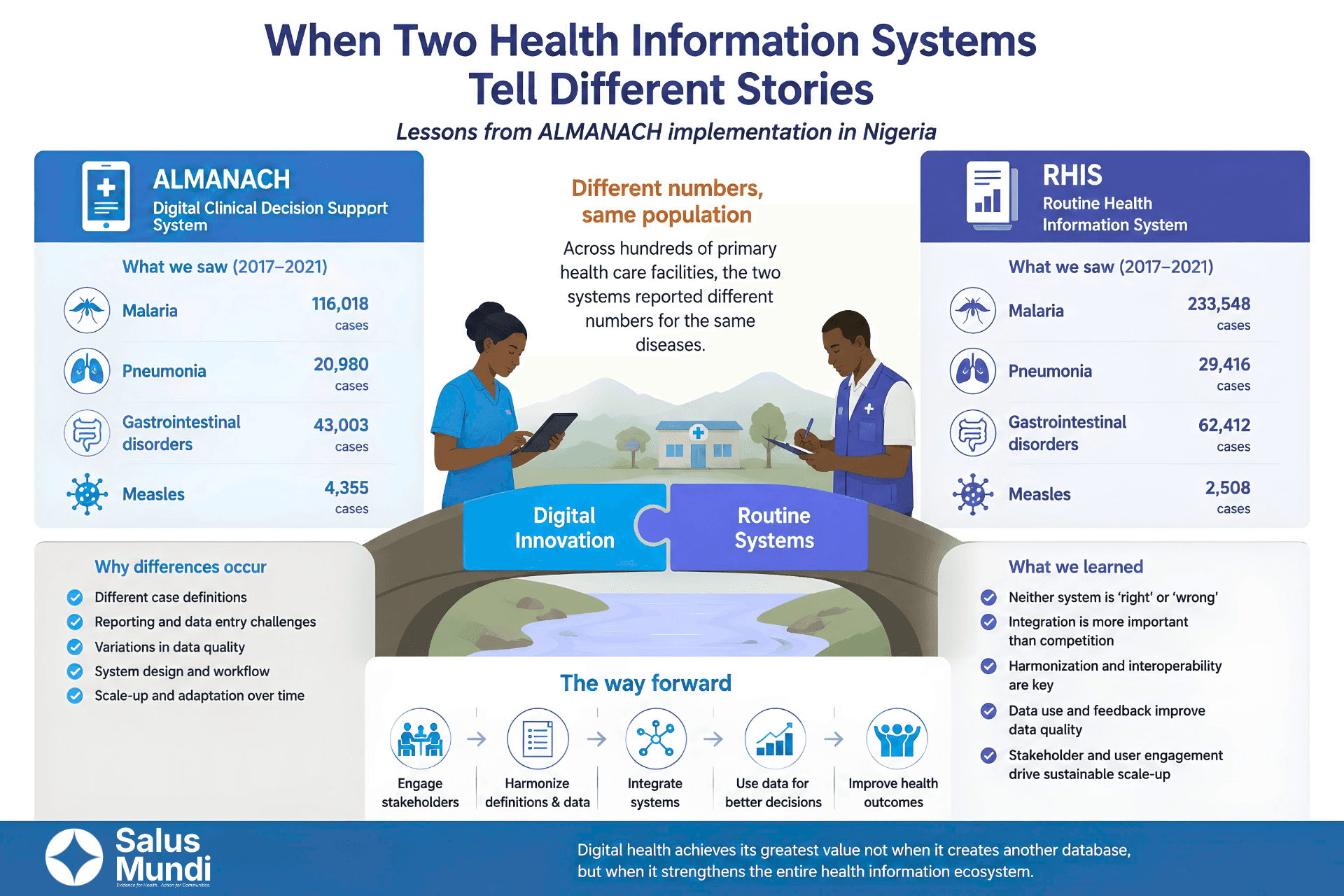
Across hundreds of facility-quarters between 2017 and 2021, important discrepancies emerged.
For malaria alone:
RHIS reported 233,548 cases
ALMANACH recorded 116,018 cases
Similar differences were observed for pneumonia and gastrointestinal diseases, while ALMANACH actually identified more measles cases than the routine reporting system.
These differences increased over time as ALMANACH expanded to more health facilities.
Why does this matter?
Health information systems are not simply databases.
They guide decisions on:
medicine procurement,
outbreak detection,
resource allocation,
programme evaluation,
donor investments,
national health policies.
When two systems describing the same population tell different stories, decision-makers face uncertainty.
Our findings do not demonstrate that either system is “right” or “wrong.” Without an external gold standard, such conclusions cannot be made.
Instead, the study highlights something equally important:
Parallel digital systems should not evolve independently from national reporting systems.
Digital health is not only about technology
One of the strongest messages emerging from this work is that successful digital health implementation depends far less on software than on governance.
Effective digital transformation requires:
harmonised case definitions;
interoperable information systems;
continuous data quality assessment;
engagement of frontline healthcare workers;
strong collaboration between digital health projects and Ministries of Health.
Without these elements, even technically successful digital platforms may generate fragmented evidence rather than strengthening health systems.
A broader lesson for global health
Around the world, governments and development partners continue to invest heavily in digital health.
These investments should increasingly focus not only on creating new digital tools, but also on ensuring that they integrate with existing national systems.
Reliable health data are the foundation of evidence-based public health.
Digital innovation achieves its greatest value not when it creates another database, but when it strengthens the entire health information ecosystem.
About the study
Bernasconi A, Ishaya D, Sahabo I, Muazu M, van der Sande M. Digital innovations and health information systems: Lessons learned from implementing ALMANACH in Nigeria. PLOS Digital Health (2026). (https://journals.plos.org/digitalhealth/article?id=10.1371/journal.pdig.0001362)
At Salus Mundi
At Salus Mundi, we believe that digital health should enhance—not replace—existing health systems. Our work focuses on helping governments, NGOs, and healthcare organizations transform routine data into reliable evidence for decision-making through epidemiology, implementation research, and digital health evaluation.
Evidence for Health. Action for Communities.