Real-World Evidence: Why Healthcare Innovation Must Prove It Works
AI, precision medicine, and digital health are reshaping what's possible in care — but only real-world evidence proves these innovations actually improve patient outcomes. See how Salus Mundi bridges that gap.
Aug 13, 2026
New technologies. Real-world evidence. Better health. Innovation in healthcare matters only when it works.
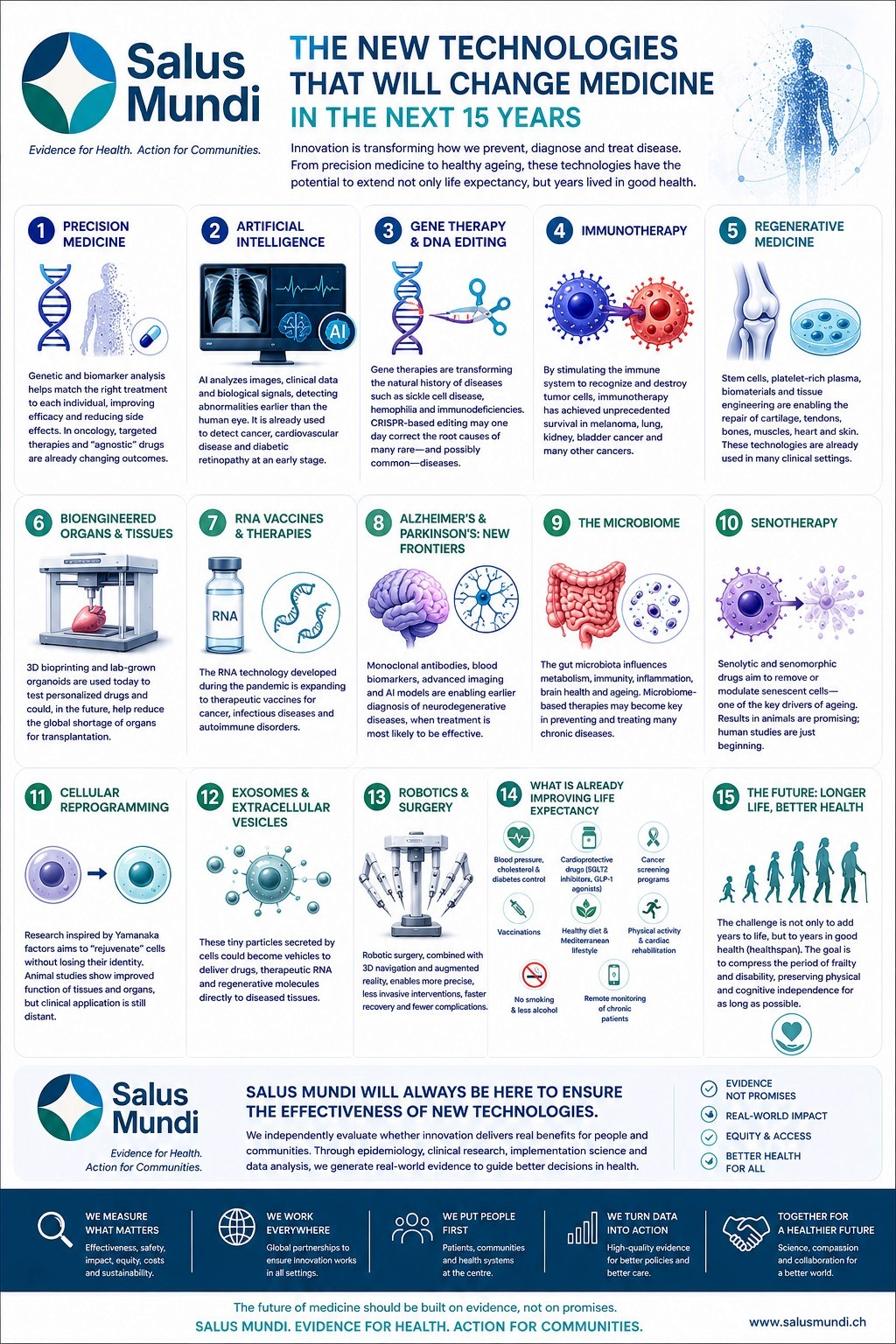
Medicine is entering a period of extraordinary technological change (see infographic).
Artificial intelligence, precision medicine, genomic technologies, digital health, advanced diagnostics, remote monitoring, regenerative medicine and new therapeutic platforms are changing what is possible in prevention, diagnosis and treatment.
But innovation alone is not enough.
A technology may perform extremely well in a laboratory, a clinical trial or a highly specialised hospital and still fail to deliver the same benefits when introduced into routine healthcare.
This is where Salus Mundi comes in.
From innovation to evidence.
At Salus Mundi, we believe that every new health technology should ultimately answer a few simple questions:
Does it work?
For whom does it work?
Does it work in real-world healthcare settings?
Does it improve outcomes that actually matter to patients?
Is it safe, accessible, equitable and sustainable?
And is the benefit worth the resources required to achieve it?
Our role is to bridge the gap between technological innovation and measurable health impact.
Through epidemiology, clinical and operational research, implementation science and healthdata analysis, Salus Mundi can contribute to the independent evaluation of new health technologies throughout their implementation in real-world settings.
The next generation of healthcare technologies will require more than traditional efficacy studies.
A digital diagnostic tool may be accurate but impossible to integrate into clinical workflows.
An artificial-intelligence algorithm may perform exceptionally well in one population and poorly in another.
A new therapy may be clinically effective but inaccessible to the populations that need it most.
A digital intervention may improve an indicator without improving patients’ lives.
For this reason, real-world evaluation must become part of innovation itself.
Our Commitment
Over the next 15 years, medicine will undoubtedly change. Some technologies currently considered experimental will become routine clinical practice. Others will disappear because their initial promise will not translate into meaningful benefits. New technologies that we cannot yet anticipate will emerge.
Whatever the technology, Salus Mundi intends to remain on the side of the evidence.
Our commitment is to independently evaluate whether innovation translates into measurable improvements in health, healthcare delivery and patients’ lives.
Because the future of medicine should not be defined simply by what technology can do.
It should be defined by what we can demonstrate that it does.